macOS Intel 11-13
Legacy Intel build for macOS 11-13
The One-Bit Delay plugin from Infinite Digits is a VST3/AU plugin inspired by the delay chips of the 1990's (like the infamous PT2399 and M50195P) that had ADC-DAC converters with one-bit data streams at their core. These chips, often using some form of delta modulation, had quantization and demodulation processes which contributed significantly to their signature sound.
The One-Bit Plugin uses a simulation of the circuitry to match those sound characteristics from those classic chips: from gurgly burps to ghostly repeats to sonorous eedback swells, the One-Bit Delay sits in its own uncanny valley — digital at its core, but with an organic, almost biological degradation pattern that makes a digital plugin actually feel alive.
Buy a license to remove all restrictions. Buy once, use forever on all computers you own.
Download and try for free. Demo version has knobs constrained, purchase a license to use it unconstrained.
Best for your system
Legacy Intel build for macOS 11-13
For macOS 14+ on Intel
2020 and later
Legacy build for older systems
Recommended for modern PCs
VST3 and Standalone
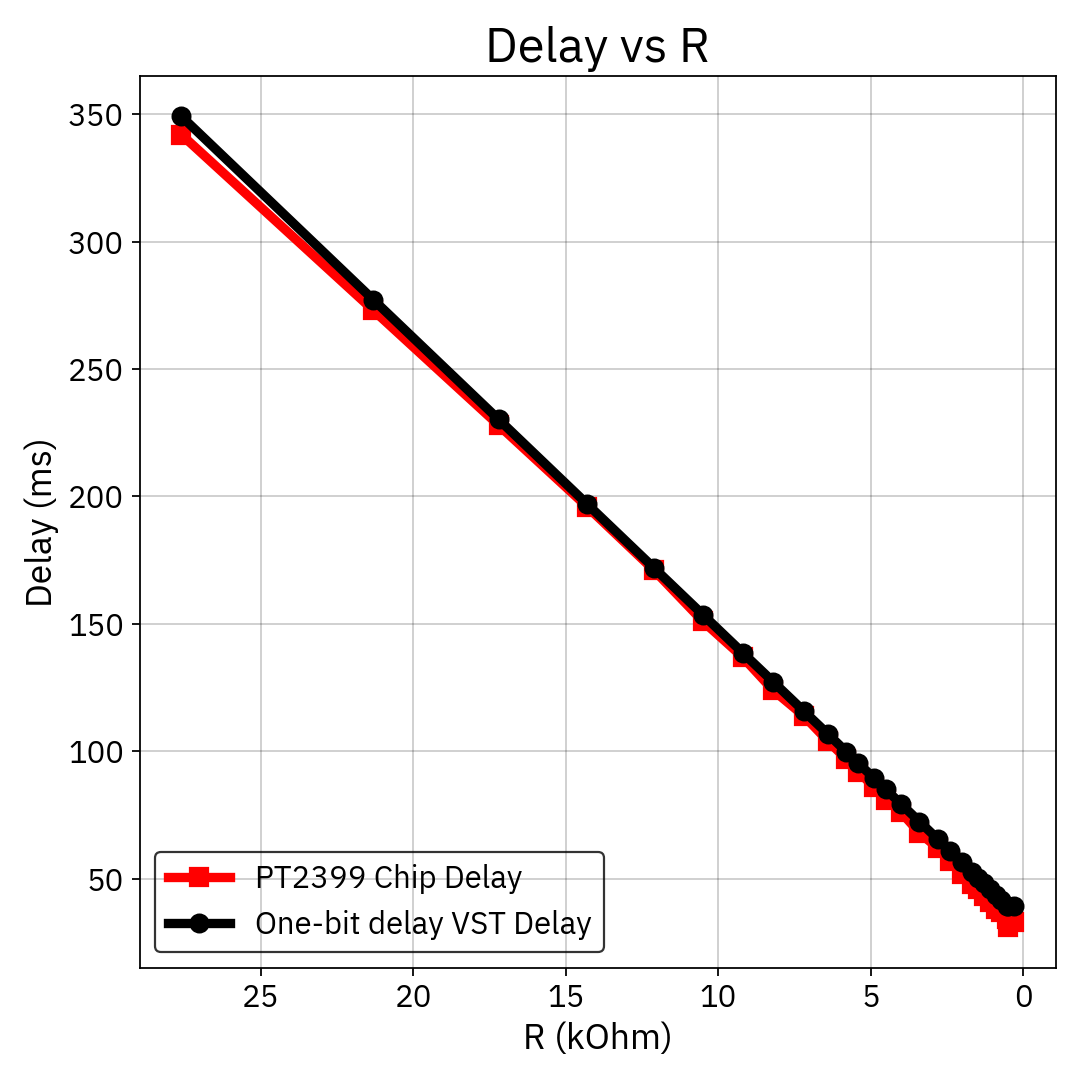
One-Bit Delay models the PT2399 delay chip at the circuit level. The Delay knob in One-Bit Delay modifies the resistance into the VCO so that the plugin delay time matches exactly with hardware.
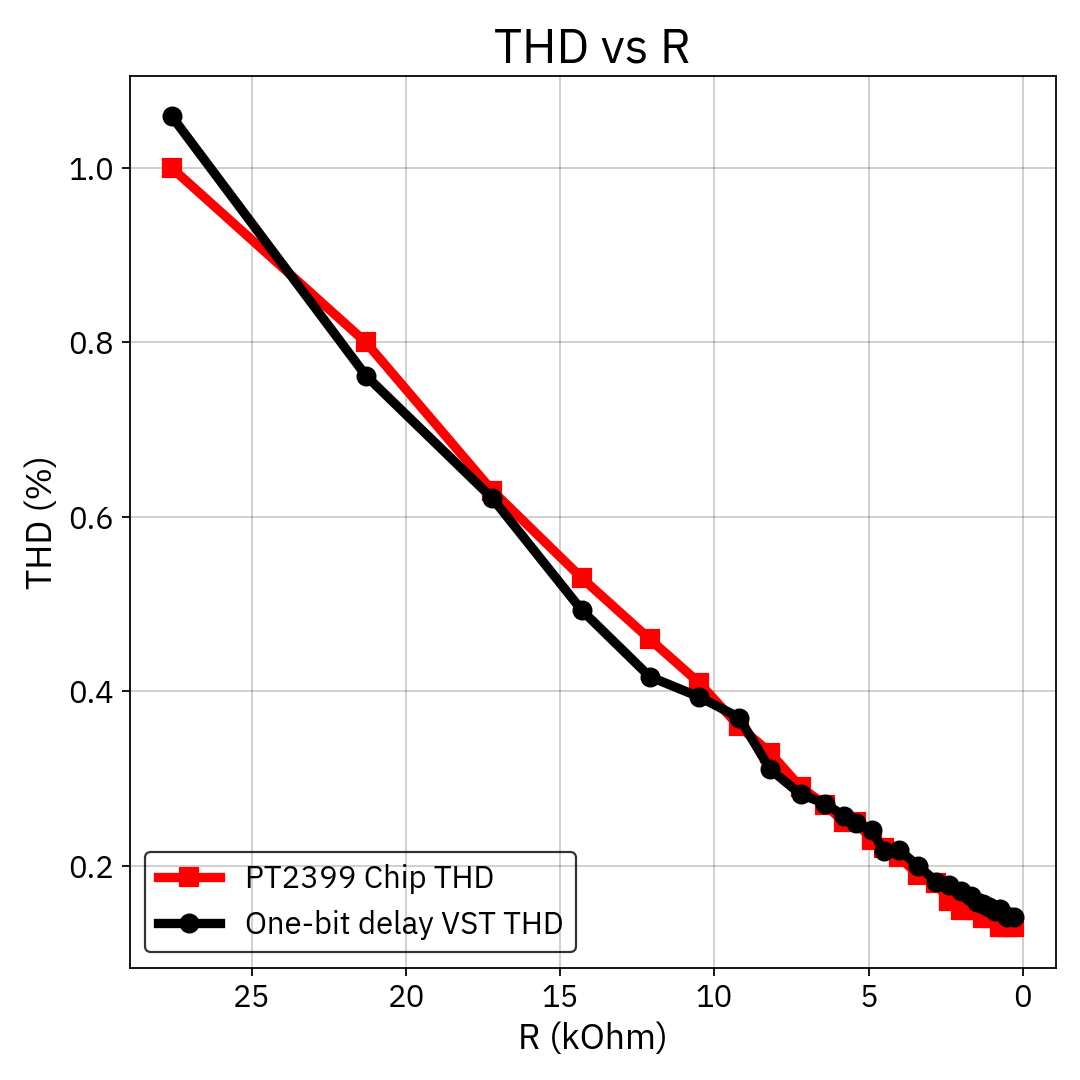
THD characteristics match hardware measurements — including the way distortion increases at shorter delay times and higher feedback settings, giving the plugin the same gritty, saturated character as the real chip.
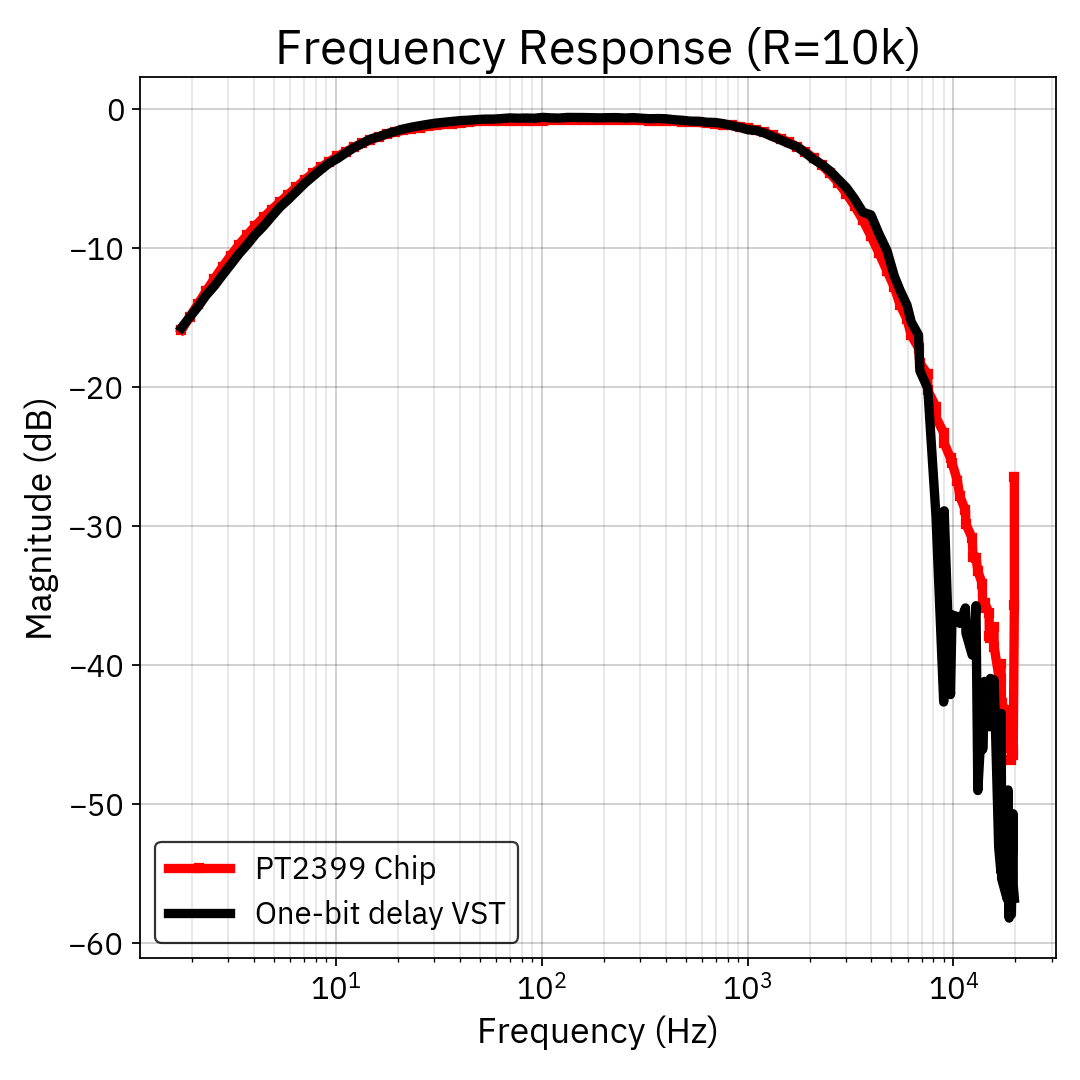
And the One-Bit Delay frequency response matches hardware — rolling off naturally above the audible range which produces those warm, dark repeats that define the sound.
"Omg I remember this sound from when I was a kid and have been searching for it ever since. So cool! Thank you!"@jimmiemarshall263
"It would be very funny if you now managed to cram this onto like a raspberry pi pico so that you can make a eurorack module, or a guitar pedal mimicking the pt2399. Like coming full circle."Instagram comment
"You just made my PT Delay obsolete ^^"Instagram comment
Most digital delays store audio as 16–24 bit samples at a fixed sample rate, delivering clean, highly accurate repeats with minimal coloration. The One-Bit Delay is different because, like classic delay chips from the 90's, the One-Bit Delay operates using an internal ADC to create a 1-bit stream saved into a small (44k) internal memory running at a variable sample rate. This has interesting effects: the tonal character shifts with delay as because it changes the sampling rate and also there is a "warmer" sound due to the presence of modulation and demodulation filters.
Noise is not a flaw, but inherent to the one-bit quantization process of classic delay chips and the One-Bit Delay plugin. With only a single bit per sample instead of the 16–24 bits used in conventional digital systems, quantization error is present. One-Bit Delay uses Delta-Sigma Modulation to manage this noise - shaping most of the noise energy above 20 kHz - although some remains audible, typically around −68 dB at 16× oversampling. As with the classic chips, the noise floor decreases with higher sampling rate (typical chips used 2-22 MHz). The One-Bit Delay plugin includes selectable oversampling from 1× to 32×, effectively increasing the sampling rate to achieve the same effect (less noise, if you want).
Yes! The realism of the One-Bit Delay comes from modeling the signal path of the PT2399 delay chip, rather than simulating its byproducts. Even down to the 44,000-bit ring memory, two-pole demodulation filter, and voltage-controlled oscillator behavior derived from the original datasheet equations. Because the structure itself is reproduced, the characteristic noise profile, harmonic distortion, bandwidth reduction at longer delays, and clock-dependent coloration arise naturally from the mathematics of the ADC-DAC instead of being artificially layered on top.
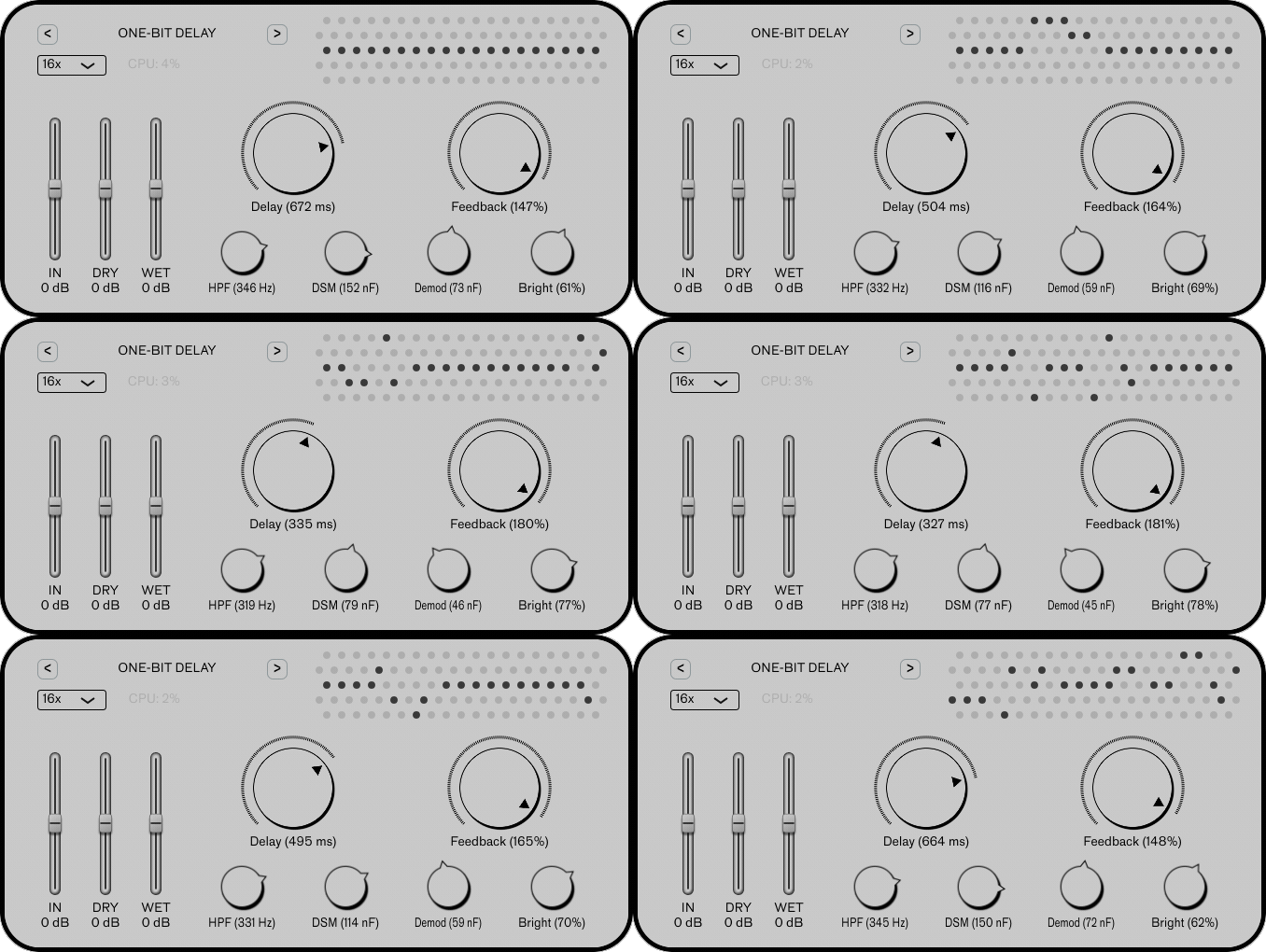
Audio enters, splits into a dry path that goes straight to the mix, and a wet path that feeds the One-Bit Delay core. Inside the core, the signal is summed with feedback, filtered by a −18 dB/oct input low-pass network, passed through op-amp saturation, and encoded by a 1-bit second-order delta-sigma modulator. The resulting bitstream is written into a clock-controlled 1-bit ring buffer, read back through a zero-order hold DAC, and reconstructed by a 2-pole (−12 dB/oct) low-pass filter before decimation and an additional −12 dB/oct output low-pass stage. A DC blocker removes low-frequency offset, after which the wet signal is both routed to the mix and sent through a feedback high-pass filter back to the input summer. Delay time sets the VCO clock that determines memory traversal speed, while C3 shapes DSM behavior, C6 sets reconstruction cutoff, Brightness adjusts the output LPF, and the Feedback control governs regeneration amount.
